
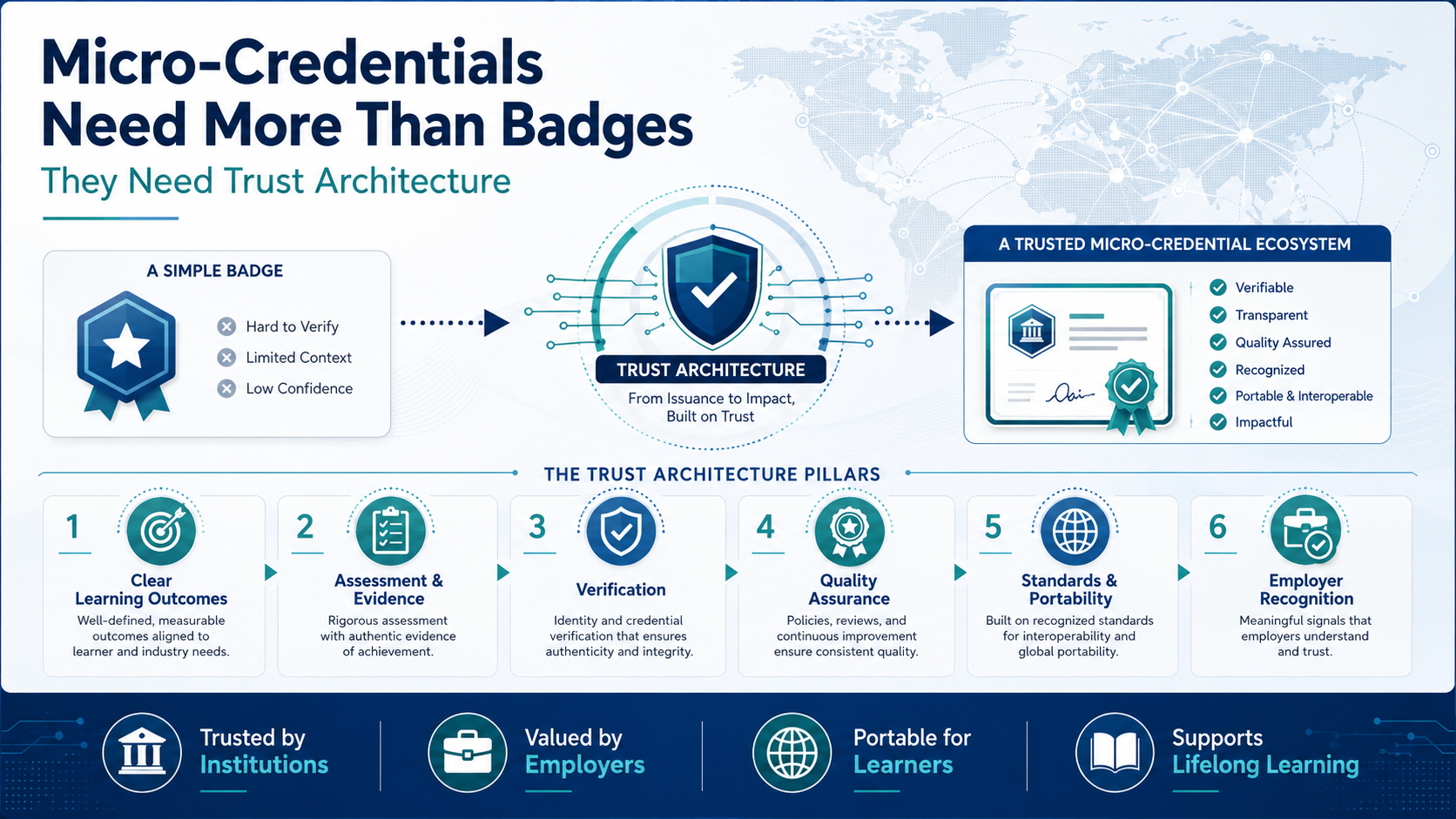
Micro-credentials are no longer a fringe innovation in education. Around the world, governments, universities, employers, and professional bodies are exploring shorter, more flexible ways to recognise learning. The logic is compelling: labour markets are changing quickly, learners need to reskill throughout life, and traditional qualifications alone may not be agile enough to meet demand.
But there is a danger in the current enthusiasm.
Too often, micro-credentials are reduced to “badges”. A learner completes a short course, receives a digital badge, adds it to LinkedIn, and the provider claims to have created a modern credentialing offer. That may be useful as a recognition tool, but it is not enough. A badge may show participation. It may show completion. It may even look professional. But the core question remains: can it be trusted?
This is why micro-credentials need more than badge design. They need trust architecture.
Trust architecture is the combination of governance, standards, verification, assessment evidence, issuer controls, quality assurance, audit trails, data protection, and outcomes tracking that gives a credential real value. Without it, micro-credentials risk becoming another layer of confusion in an already crowded skills market.
The global policy direction is clear. The European Union adopted a Council Recommendation in 2022 to support the development, implementation, and recognition of micro-credentials across institutions, businesses, sectors, and borders. Its stated aim is to support lifelong learning and employability through a common European approach, including shared definitions, standards, and principles for design and issuance.
The OECD has also highlighted both the promise and the limitations of micro-credentials. Its work notes that micro-credentials may support labour market participation, higher education pathways, completion, and social inclusion, but also warns that evidence on their value and impact remains limited. This is an important point: micro-credentials will not gain lasting trust simply because they are short, digital, or employer-facing. They must prove their worth through evidence, recognition, and outcomes.
UNESCO has similarly framed micro-credentials as part of a bigger learning ecosystem rather than as a standalone solution. In 2025, UNESCO argued that micro-credentials can make learning more agile, flexible, and diverse, but should be understood within broader education and recognition systems.
Different countries are now developing this infrastructure in their own ways. Australia’s National Microcredentials Framework places quality assurance at the centre of ecosystem integrity, arguing that it gives employers and recognising bodies confidence in micro-credentials and protects learners. New Zealand has gone further by integrating quality-assured micro-credentials into its qualifications and credentials framework; NZQA states that quality-assured micro-credentials are listed on the New Zealand Qualifications and Credentials Framework and generally range from 1 to 40 credits. India’s Academic Bank of Credits, created under the National Education Policy 2020, is designed to support student mobility through digital credit accumulation and transfer across higher education institutions.
These examples show that the future of micro-credentials is not just about issuing more badges. It is about building systems that allow learning to be recognised, transferred, verified, and trusted.
For employers, this distinction matters. A hiring manager does not simply need to know that a candidate has collected badges. They need to know what those badges mean. Was the learner assessed? What skills were demonstrated? What standard was used? Who issued the credential? Is the issuer credible? Can the achievement be verified? Is the credential current? Does it map to a role, occupation, licence, or competency framework?
A weak micro-credential answers few of these questions. A strong micro-credential answers them clearly.
This is why metadata matters. Open Badges, developed by 1EdTech, provide a structured way to package information about achievements such as micro-credentials, skills, competencies, and degrees. Open Badges are not just visual tokens; they include defined metadata that can help describe what was achieved and who issued it. The move to Open Badges 3.0 is especially important because it is designed around W3C Verifiable Credentials, strengthening the security, portability, and verifiability of digital achievements.
However, standards alone are not enough. A technically verifiable badge can still represent a weak learning experience. Trust architecture must therefore connect the technical layer to the educational layer.
That means every meaningful micro-credential should have a clear purpose. It should define the learner need, employer need, or progression need it addresses. It should state the level, volume of learning, learning outcomes, assessment method, evidence requirements, issuer authority, quality assurance process, and recognition pathway. It should also be clear whether the credential stands alone, stacks into a larger award, contributes to credit, supports professional development, or provides evidence for employment.
This is where many micro-credential strategies fail. They focus on speed to market but not on credibility. They create attractive badges but weak governance. They talk about employability but do not involve employers in design or validation. They offer flexibility but fail to explain how credentials stack or transfer. They use digital language but do not provide independent verification.
For universities and awarding bodies, the opportunity is significant. Micro-credentials can support lifelong learning, alumni engagement, employer partnerships, workforce upskilling, international education, and flexible entry routes into formal qualifications. But this opportunity will only be realised if institutions protect the value of their brand. A university badge should not be a lightweight marketing asset. It should be a trusted signal of learning.
For regulators and quality assurance bodies, the task is to encourage innovation without allowing credential inflation. Not every short course needs to become a regulated qualification, but every credential that claims value should be transparent about its evidence base. The right question is not “is this digital?” The right question is “is this credible, verifiable, and useful?”
For learners, trust architecture protects value. Learners invest time, money, and reputation in credentials. They need confidence that what they earn will be recognised, understood, and portable. A badge that cannot be interpreted by employers or accepted by institutions may have limited long-term value. A trusted micro-credential, however, can become part of a lifelong skills portfolio.
AlmaBridge is built around this exact challenge. It treats credentials not as isolated badges, but as part of a wider trust infrastructure connecting digital credential management, skills mapping, verification, auditability, and employability outcomes.
The future of micro-credentials will not be won by those who issue the most badges. It will be won by those who create the most trusted evidence of learning.
A badge may show that learning happened. Trust architecture proves why it matters.