
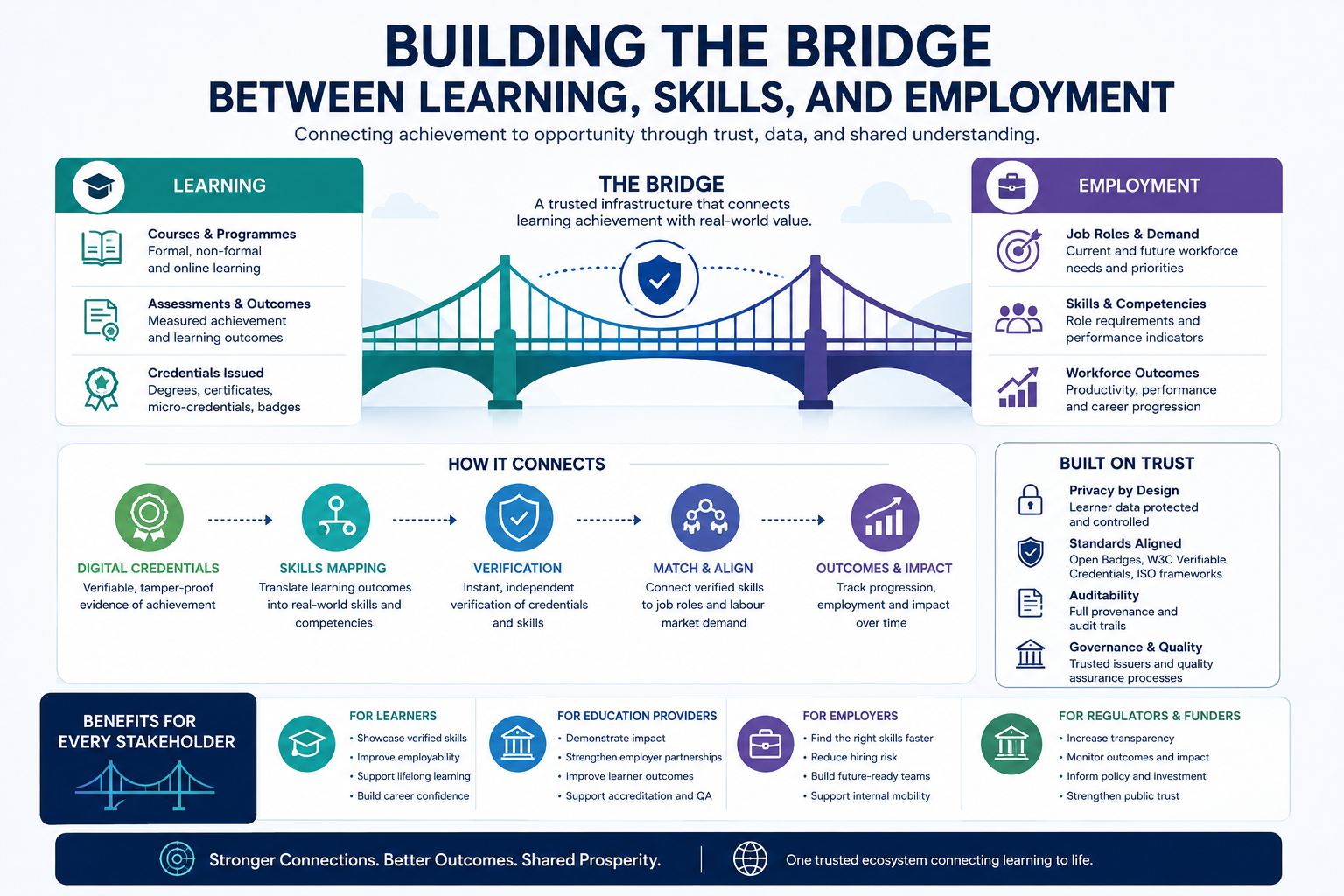
Education and employment are closely connected, but they do not always speak the same language.
Universities, colleges, awarding bodies, and training providers describe achievement through qualifications, modules, credits, certificates, learning outcomes, and assessment criteria. Employers describe need through job roles, competencies, experience, behaviours, compliance requirements, and performance expectations. Learners sit between these two worlds, trying to translate what they have learned into evidence that employers understand and value.
This translation gap is one of the biggest challenges in the modern skills economy.
A learner may complete a strong programme but struggle to explain how it connects to a role. An employer may need specific capabilities but find it difficult to interpret unfamiliar qualifications. A university may design a course with clear learning outcomes, but those outcomes may not be visible in recruitment. An awarding body may issue a certificate, but the practical skills behind that certificate may remain hidden.
The result is friction. Learners miss opportunities. Employers overlook talent. Institutions struggle to evidence impact. Regulators and funders ask for stronger proof that education leads to meaningful outcomes.
This is why we need a stronger bridge between learning, skills, and employment.
Digital credentials are one part of that bridge. A well-designed digital credential does more than confirm that a learner completed a course. It can carry structured information about what was achieved, who issued it, when it was awarded, what level it represents, how it was assessed, and how it can be verified. This turns a credential from a static certificate into trusted evidence of achievement.
But credentials alone are not enough.
The real value comes when credentials are connected to skills. Skills mapping allows learning outcomes to be translated into language that employers can use. It helps show how a module, qualification, micro-credential, or professional award relates to practical capability. For example, a course outcome may state that a learner can “evaluate organisational risk.” Skills mapping can connect this to employer needs such as risk analysis, compliance reporting, governance awareness, decision-making, and audit preparation.
This matters because employers are not simply buying qualifications. They are looking for capability.
A trusted skills system must therefore answer three questions. First, what has the learner achieved? Second, what skills does that achievement represent? Third, where can those skills create value in the labour market?
AlmaBridge is designed around this connection.
AlmaBridge supports digital credential management, skills mapping, qualification verification, and employability alignment. The aim is to help institutions move beyond issuing certificates and towards building trusted learner records that can support progression, recruitment, compliance, and lifelong learning.
For learners, this creates a clearer pathway. Instead of relying only on a CV, they can present verified evidence of their achievements and skills. This is especially valuable for people changing careers, returning to work, building portfolios of micro-credentials, or seeking international opportunities. Their learning becomes more visible, portable, and credible.
For employers, the benefit is better evidence. They can verify credentials more easily, understand what a learner can do, and make more confident recruitment and workforce development decisions. This can reduce hiring risk, improve skills matching, and support internal talent mobility.
For education providers, the opportunity is strategic. By connecting credentials to skills and outcomes, institutions can demonstrate the labour market relevance of their programmes. They can strengthen employer partnerships, improve graduate outcomes, support lifelong learning, and provide better evidence for quality assurance and impact reporting.
For regulators and funders, this creates a more transparent system. Digital credentials and skills mapping can help show the relationship between approved learning, assessment, certification, employment progression, and social value. This makes education outcomes easier to understand, monitor, and improve.
The future of learning will not be defined only by the number of courses offered or certificates issued. It will be defined by the strength of the connections between learning achievement, verified skills, and real-world opportunity.
A bridge is needed because no single stakeholder can solve this alone. Institutions create learning. Learners build capability. Employers create demand. Regulators protect trust. Technology can connect these actors through a shared infrastructure of evidence.
That is the role AlmaBridge aims to play: helping education and employment systems become more connected, transparent, and trusted.
Learning should not end with a certificate. It should open a pathway.
When credentials are verified, skills are mapped, and outcomes are visible, learners can move with confidence, employers can hire with trust, and institutions can prove the value of what they deliver.