
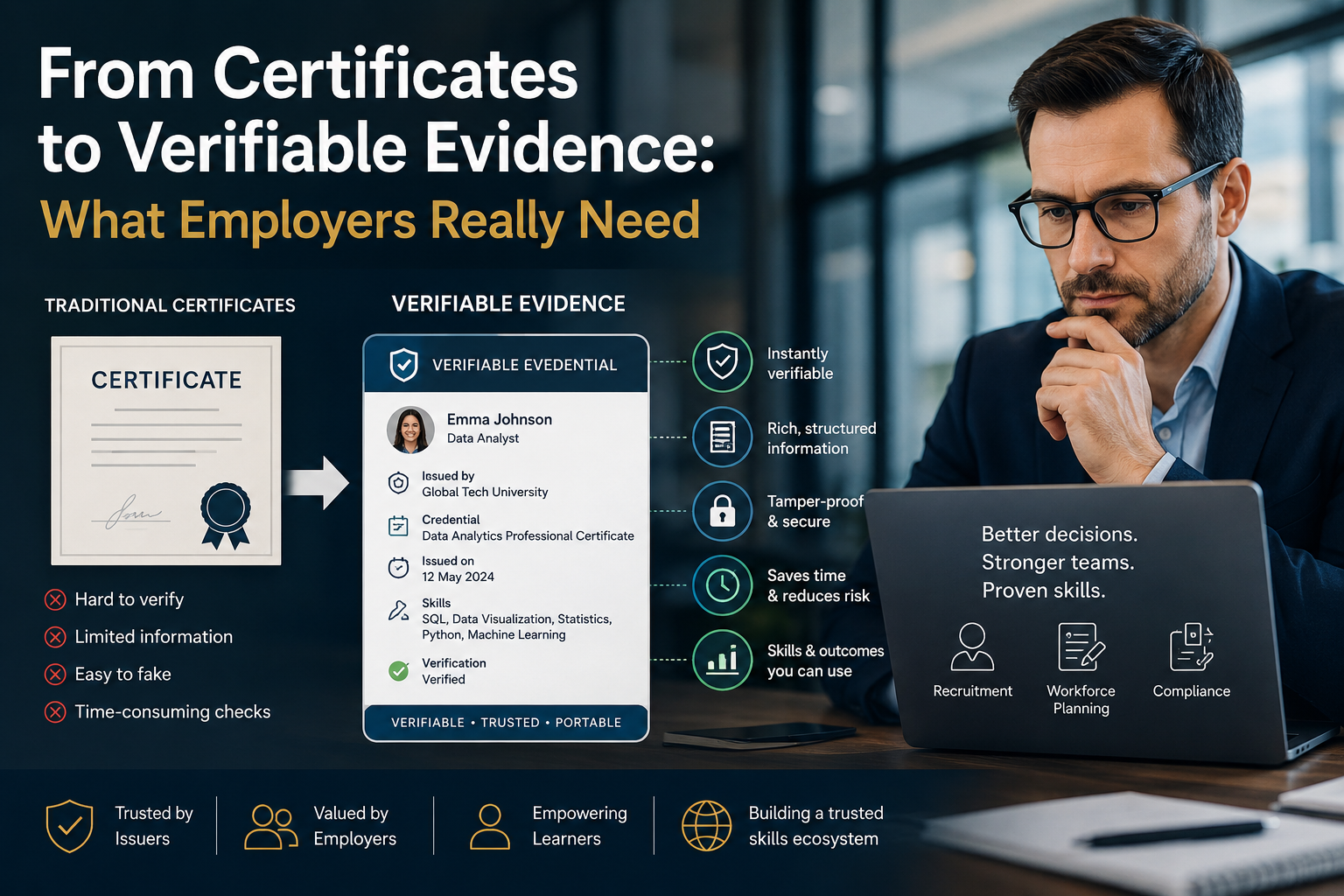
For decades, certificates have acted as shorthand for achievement. A candidate presents a qualification, an employer recognises the issuing institution, and the certificate becomes part of the recruitment decision. In many cases, this still works. Degrees, diplomas, apprenticeships, professional certificates, and industry awards continue to carry value.
But the labour market has changed.
Employers now operate in a faster, more complex skills environment. Roles are evolving quickly. Compliance expectations are rising. Digital transformation is reshaping job requirements. Short courses, micro-credentials, workplace learning, bootcamps, online programmes, and professional development awards are now part of the skills landscape. As a result, employers are no longer asking only: “Does this person have a certificate?”
They are asking: “What does this certificate prove?”
That question is at the heart of the shift from certificates to verifiable evidence.
A traditional certificate may confirm that a person completed a programme or achieved a qualification. However, it often provides limited detail. It may not show the specific skills developed, the assessment method used, the level of competence demonstrated, the currency of the achievement, or its relevance to a particular role. Employers are left to interpret the meaning of the credential themselves.
This creates friction.
Recruitment teams spend time checking whether qualifications are genuine. Hiring managers compare candidates whose credentials are difficult to interpret. HR departments rely on CV claims that may not be independently verified. In regulated sectors, employers must also demonstrate that staff hold appropriate qualifications, training, or continuing professional development. The more manual this process becomes, the greater the cost, delay, and risk.
The issue is not that certificates are meaningless. The issue is that certificates alone are often insufficient.
Employers need evidence that is trusted, structured, and usable.
A verifiable digital credential can provide this. Instead of being a static document, it can contain structured information about the achievement. This may include the issuing organisation, qualification level, learning outcomes, assessment criteria, evidence of competence, issue date, expiry date, renewal requirements, and verification status. It can also be linked to skills frameworks, occupational standards, professional requirements, or employer-defined capabilities.
This changes the role of the credential. It becomes not just a claim of achievement, but an evidence object.
For employers, this has immediate value. A verifiable credential can help confirm authenticity quickly. It can reduce the burden of manual checking. It can make it easier to understand what a candidate actually knows and can do. It can support onboarding, compliance, workforce planning, talent development, and internal mobility.
Consider a cyber security role. Two candidates may both list cyber-related qualifications on their CVs. But an employer needs to know more than the title of the course. Did the learner demonstrate risk assessment capability? Were they assessed on governance, incident response, technical controls, or regulatory compliance? Is the credential current? Was it issued by a credible body? Can it be verified?
The same logic applies across health, education, financial services, construction, engineering, digital, sustainability, and governance roles. Employers increasingly need evidence of applied capability, not just attendance or participation.
This is especially important for newer forms of learning. Micro-credentials and digital badges can be powerful, but only if they are meaningful. A badge that simply says “completed” may have limited value. A credential that shows learning outcomes, assessment evidence, level, standards alignment, and verification status is much more useful.
Employers are not asking for more badges. They are asking for better signals.
This is where education providers, awarding bodies, and universities have an important opportunity. By issuing digital credentials that are rich in evidence, they can strengthen the employment value of their programmes. They can help employers understand the skills behind the qualification. They can make graduate outcomes more visible. They can also support lifelong learning by allowing learners to build trusted portfolios over time.
For learners, this shift is equally important. A CV asks employers to trust self-description. A verifiable credential allows learners to present proof. It gives individuals portable evidence of achievement that they can share across job applications, professional networks, further study, and career transitions. This is particularly valuable for people changing careers, returning to work, entering regulated professions, or building skills through non-traditional routes.
However, verifiable evidence must be designed carefully. It is not enough to digitise a certificate or create an attractive badge. The credential must be linked to governance. Employers need confidence that the issuer is legitimate, the assessment is meaningful, the data is reliable, and the credential can be independently checked.
This means digital credentials need trust architecture.
Trust architecture includes clear issuer controls, assessment links, credential metadata, verification mechanisms, privacy safeguards, audit trails, revocation processes, and alignment with recognised standards. Without these features, digital credentials risk becoming another layer of confusion. With them, they become infrastructure for a better skills economy.
The employer benefit is not only recruitment efficiency. It is strategic workforce intelligence.
When credentials are structured and verifiable, employers can start to map workforce capability more accurately. They can identify skills gaps, plan reskilling, support compliance reporting, and understand progression pathways. They can move from informal assumptions about capability to evidence-based talent decisions.
This matters because the future labour market will depend on continuous skills development. Few organisations can rely only on qualifications gained at the start of a career. Employees will need to update, extend, and evidence their capabilities throughout their working lives. Employers will need systems that can recognise this learning and connect it to organisational needs.
AlmaBridge is designed around this shift.
AlmaBridge connects digital credential management, skills mapping, qualification verification, and employability. The aim is to help institutions and employers move beyond static certificates towards trusted evidence of achievement. This supports learners, reduces verification friction, strengthens institutional credibility, and gives employers better insight into skills and readiness.
Certificates will not disappear. They will remain important symbols of achievement. But the future belongs to credentials that can do more than sit in a file or attach to an application.
Employers need credentials that can be verified. They need credentials that explain what was learned. They need credentials that connect to skills, roles, and standards. They need credentials that provide evidence, not just assertion.
In a world where skills are changing quickly and trust is increasingly important, the question is no longer whether someone has a certificate.
The real question is whether the achievement behind that certificate can be trusted, understood, and used.