
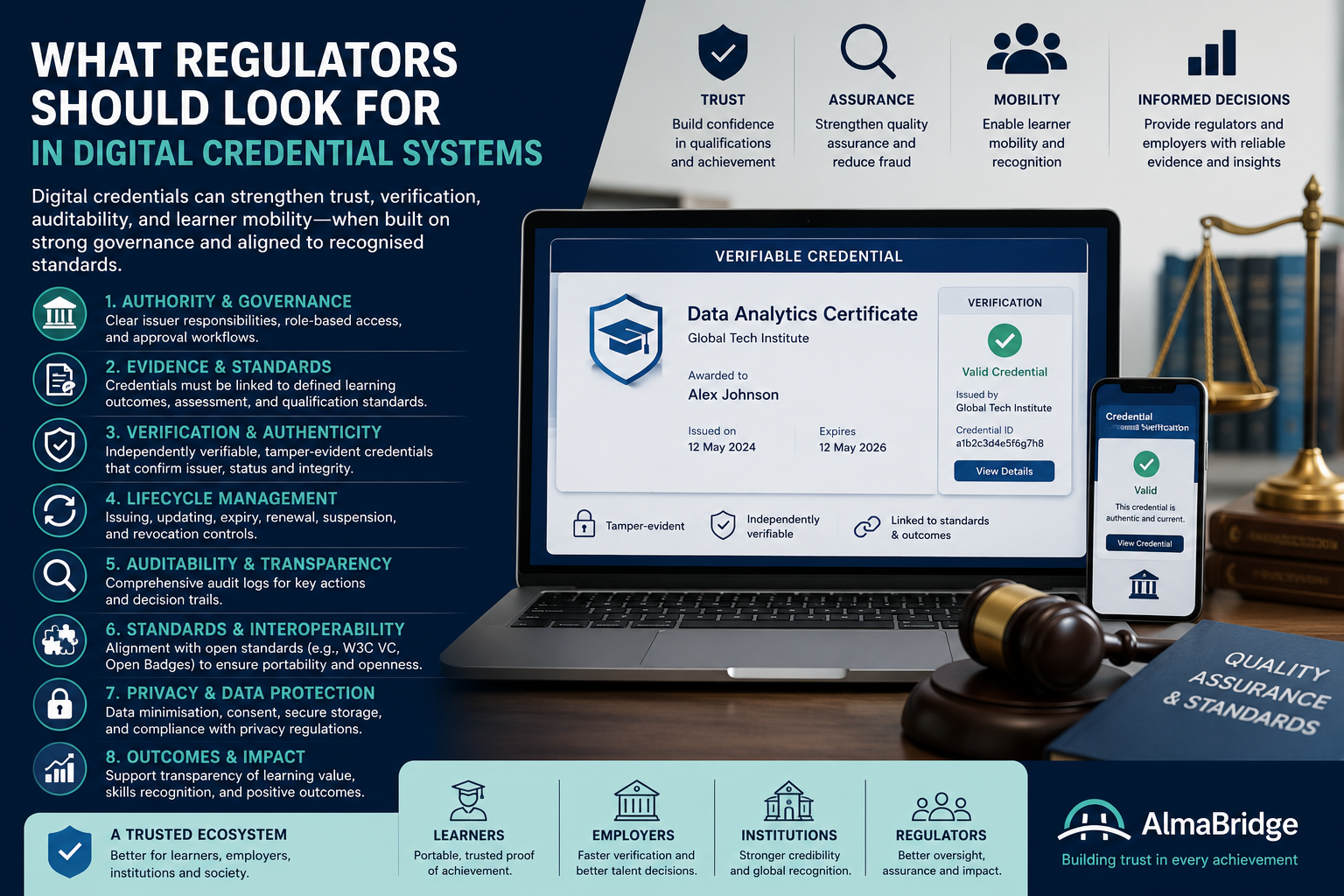
Digital credentials are becoming an important part of modern education, professional training, and workforce development. Universities, awarding bodies, training providers, employers, and technology platforms are increasingly issuing digital certificates, badges, micro-credentials, and verifiable learning records.
For regulators, this creates both an opportunity and a risk.
The opportunity is clear. Digital credentials can reduce fraud, improve learner mobility, support faster verification, strengthen audit trails, and create better evidence of learning outcomes. They can help regulators understand not only whether a qualification was issued, but who issued it, under what authority, against which standard, and with what evidence.
The risk is equally clear. Poorly designed digital credential systems can create confusion, weaken quality assurance, and allow unverified claims to appear more credible than they really are. A digital badge may look professional, but that does not mean it represents assessed competence, regulated achievement, or reliable institutional approval.
This is why regulators should not judge digital credential systems by appearance alone. They should assess the trust architecture behind them.
The first question is authority. Who is allowed to issue the credential? A credible system must have clear issuer controls, role permissions, approval processes, and accountability. Regulators should expect to see governance arrangements showing which organisations, departments, or individuals can create, approve, issue, amend, suspend, or revoke credentials.
The second question is evidence. A credential should not simply state that a learner completed something. It should be connected to defined learning outcomes, assessment criteria, qualification specifications, or competency standards. Where appropriate, it should also show whether achievement was based on attendance, participation, assessment, professional judgement, workplace evidence, or formal examination. This distinction matters because different credentials carry different levels of assurance.
The third question is verification. A digital credential should be independently checkable. Employers, institutions, and authorised stakeholders should be able to confirm whether the credential is genuine, current, and issued by a recognised body. Verification should not depend only on a screenshot, PDF, or learner claim. It should be supported by secure digital mechanisms that confirm authenticity and status.
The fourth question is lifecycle control. Credentials are not static. They may need to expire, renew, update, suspend, or be revoked. Regulators should ask how the system manages the full credential lifecycle. If a credential was issued in error, can it be revoked? If a qualification changes, can records remain historically accurate? If professional competence requires renewal, can expiry and renewal rules be applied?
The fifth question is auditability. A regulator should be able to understand what happened, when it happened, and who authorised it. Strong systems maintain audit logs for key actions such as credential creation, approval, issuing, verification, amendment, and revocation. This supports quality assurance, complaints handling, malpractice investigations, and regulatory review.
The sixth question is standards alignment. Digital credential systems should not operate as closed, isolated databases. They should align where possible with recognised standards such as Verifiable Credentials, Open Badges, and other sector-relevant frameworks. Standards alignment supports portability, interoperability, and long-term resilience. It also reduces the risk that learners become locked into one platform or issuer ecosystem.
The seventh question is privacy and data protection. Credentials may contain personal data, assessment information, or sensitive learning records. Regulators should expect systems to follow data minimisation, consent, access control, and security principles. Learners should understand what information is included, who can see it, and how it can be shared.
Finally, regulators should consider outcomes. A strong digital credential system should help connect qualification design, learner achievement, employer recognition, and progression. It should make the value of regulated learning more visible without lowering standards.
AlmaBridge approaches digital credentialing as trust infrastructure, not simply a certificate design tool. The goal is to support credible issuing, verification, skills mapping, auditability, and outcomes tracking across education and employment ecosystems.
For regulators, the central test is simple: can this system be trusted?
If the answer is yes, digital credentials can strengthen public confidence in qualifications. If the answer is no, they risk becoming another layer of unsupported claims in an already complex skills market.