
Education systems are no longer judged only by what they teach. They are increasingly judged by what learners can prove, how quickly that proof can be trusted, and whether learning achievements translate into employment, progression, compliance, and lifelong opportunity.
This is why digital credentials are becoming core education infrastructure.
For many years, certificates have acted as the formal endpoint of learning. A learner completes a course, passes an assessment, and receives a certificate or transcript. That document may carry institutional authority, but it was designed for a slower, paper-based world. In today’s environment, employers need faster verification, universities need better evidence of outcomes, learners need portable records of achievement, and regulators need stronger audit trails.
A PDF certificate is not enough. A scanned document is not enough. Even a digital badge is not enough unless it carries verified, structured, and trustworthy information.
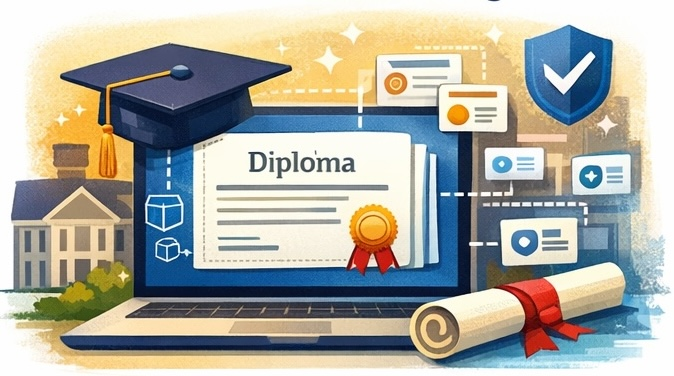
Digital credentials provide a new model. At their best, they are not simply digital versions of paper certificates. They are structured records of achievement that can include the issuer, learner, qualification, level, learning outcomes, assessment basis, issue date, expiry date, verification status, and evidence links. Standards such as W3C Verifiable Credentials allow credentials to be expressed in a way that is cryptographically secure, privacy-respecting, and machine-verifiable. (W3C)
This matters because education is becoming more fragmented and more flexible. Learners now build capability through degrees, apprenticeships, professional certificates, micro-credentials, workplace learning, short courses, online learning, and continuing professional development. A single qualification may no longer tell the full story of a person’s skills. Instead, learners need a trusted portfolio that can grow with them across their career.
For universities, this creates both a challenge and an opportunity. The challenge is that institutional value must now be demonstrated beyond enrolment, completion, and graduation. Universities must show how learning connects to employability, skills development, professional recognition, and lifelong engagement. The opportunity is that digital credentials can make this value more visible.
A well-designed credential can show not only that a learner completed a programme, but what they achieved. It can expose learning outcomes in a structured way. It can link achievement to skills frameworks, occupational standards, professional requirements, or employer needs. It can help an institution demonstrate the real-world relevance of its curriculum.
For employers, digital credentials reduce friction and uncertainty. Recruitment teams regularly face the task of interpreting unfamiliar qualifications, checking authenticity, comparing applicants, and identifying relevant skills. In regulated or high-trust sectors, this is even more important. Employers need to know whether a credential is genuine, current, and issued by a credible organisation. They also need to understand what the credential means in practical terms.
Digital credentials can make recruitment and workforce planning more evidence-based. They allow employers to verify achievement more quickly and understand the skills behind the certificate. This is particularly valuable in fast-changing areas such as cyber security, sustainability, health, digital transformation, governance, and advanced manufacturing, where skills needs evolve faster than traditional qualification cycles.
For learners, the value is personal and practical. A digital credential gives individuals portable evidence of what they know and can do. It allows them to share verified achievement with employers, universities, professional bodies, and international partners. This is especially important for learners moving between countries, sectors, institutions, or career stages.
Open Badges are one example of this shift. The Open Badges specification provides a way to package information about an achievement, such as a micro-credential, skill, competency, or degree, using rich metadata that can be shared electronically. (1EdTech) Open Badges 3.0 also aligns with the W3C Verifiable Credentials Data Model, which strengthens the connection between recognition, verification, and interoperability. (imsglobal.org)
For regulators and quality assurance bodies, digital credentials offer a new layer of trust infrastructure. They can support clearer evidence trails between approved qualifications, assessment decisions, issuing processes, certification, and outcomes. They can also help reduce fraud, improve transparency, and support better monitoring of credential lifecycle events, including issue, update, renewal, suspension, and revocation.
This is why digital credentials should not be treated as a marketing add-on. They are part of institutional governance.
A credible digital credential system must answer several questions. Who is authorised to issue the credential? What evidence supports it? What standard or qualification does it relate to? Can it be independently verified? Can it be revoked if issued in error? Does it protect learner privacy? Does it align with recognised technical and educational standards?
The European Digital Credentials for Learning model shows how this infrastructure can support diplomas, training certificates, micro-credentials, certificates of participation, and other learning credentials in a standardised digital form. (Europass) This points to a wider direction of travel: education records are becoming more portable, more verifiable, and more connected to digital identity and skills systems.
For institutions, the strategic implication is clear. The future education ecosystem will depend on trust architecture. Learning management systems will still matter. Student record systems will still matter. But they will increasingly need to connect with credential infrastructure that supports verification, auditability, interoperability, and outcomes tracking.
This is where AlmaBridge is focused.
AlmaBridge helps connect digital credential management, skills mapping, qualification verification, and employability. The purpose is not simply to issue more credentials. It is to help institutions, employers, learners, and regulators trust the evidence behind achievement.
Digital credentials are becoming core education infrastructure because they solve a fundamental problem: how to make learning visible, verifiable, portable, and useful.
The next phase of education will not be defined only by who can deliver learning. It will be defined by who can prove the value of learning in a way that others can trust.